Thursday, October 7, 2010

African Immigrants in China

Interesting little article in The Guardian dealing with the plight of African immigrants in China, focussing on their experience in the city of Guangzhou. As a former resident of Guangdong's capital city, the article brought back memories of my own period wandering around Shamian Island and Tianhe, and in particular it reminded me of just how large the African and Middle Eastern communities in the city are.

When I first moved to Guangzhou, I had expected the locals to react to foreigners in a similar vein to the citizens of other Chinese cities I had lived in or visited. As any foreigner who has been to China, from two-week tourists to long-time residents, will tell you, being stared at in the street is not uncommon, even in places as cosmopolitan as Beijing. Similarly, even in Shanghai I did, on occasion, hear mutters of "laowai" (literally "old foreigner") as I walked down the street. But in Guangzhou, the local populace is basically indifferent to foreigners - at least to those from the West.

So close to Hong Kong, and with so many foreign owned factories and enterprises in Guangdong, the presence of "da bizi" ("big noses") is now very common. But what is quite unique to Guangzhou is the large number of immigrants from Africa and the Middle East- sadly, they are not greeted with the same acceptance shown to, well, white people.

Even the best educated and worldly of my Chinese colleagues could be quite spectacular in their casual racism, towards Africans in particular, and I was solemnly informed that while Europeans and Americans who visited China tended to be decent and hard-working, most Africans were not to be trusted. Inevitably, such distrust leads to reinforcing patterns of behaviour, with the locals reluctant to lease apartments to Africans, consequently resulting in these immigrants concentrating in less salubrious areas with landlords who are not too picky, effectively creating ghettoes. Similarly, the fact that immigrants from Africa find it so hard to get visas to work in China means that some, by necessity, have to turn to less legitimate forms of work - around the Garden Hotel, for example, the drug dealers catering for Western visitors were predominantly African.

True, the immigrants themselves sometimes engage in behaviour that does not endear them to the locals. As someone who, with typical Irish Catholic guilt, cannot miss mass even when living in a state with atheism as its official faith, I regulalry attended mass in the Sacred Heart Cathedral near the banks of the Pearl River. The English language service was organised and mainly attended by African immigrants, with the ushers being entirely drawn from the immigrant community. These ushers could take quite a dictatorial line when ordering people to their seats, or when kicking people out for being improperly clad (i.e. wearing shorts) or committing similarly abominable acts. But they seemed to take a particular delight in ordering Chinese massgoers about (some of whom were merely curious locals, eager to see what actually took place in the cavernous building, but many were genuine Chinese Catholics, trying to practice their faith). At times, the racial tension between African and Chinese Catholics was palbable.

What is clear, though, is that China cannot afford to treat African immigrants as a problem - the influx of migrants from the continent is a by-product of China's investment there, and a beneficial one to boot. Almost all of the immigrants are of a commercial bent, and offer economic bonuses not only to friends and family at home, but also to the local Chinese with whom they trade. As China grows to play a more dominant role in Africa, such migration, and the bonuses associated, will only increase. China needs to learn to smooth out any problems or tensions that result. Furthermore, in days to come when China's interest in Africa extends beyond the merely commercial, and develops further along diplomatic lines, the PRC's own African community will be able to serve as an invaluable intermediary.

Wednesday, October 6, 2010

Corporation Tax - The Deal Breaker?

Recently, much fevered and fearful discussion has taken place over the seeming suggestion by Olli Rehn, European Commissioner for Economic and Monetary Affairs, that Ireland might have to relinquish its relatively low corporation tax rate of 12.5%, and adopt a more continental tax rate. This, it is claimed, will scare away many of the foreign Multi-National Corporations (MNC) which have established in Ireland.

Despite the fact that, as Central Bank Governonr Patrick Honohan noted on Vinnie B's show on Monday, Ollie Rehn never actually threatened our corpo tax rate ("Ireland can no longer be a low tax economy" does not mean higher corpo tax- he may be referring to the inevitable rise in our income tax) the kerfuffle that ensued following Rehn's comments did give me pause for thought - would we really be screwed if we raised the corpo tax rate?

Jaysus, would we ever! By way of illustration, let me tell you about a certain US MNC, operating in a realtively high-tech sector, which I am dealing with as part of my day job. Currently, I'm "on safari" at their facility in the southwest of the country, and being on the ground with the exporting economy has been very revealing. Business for this MNC is flying - they have just hired a whole new bunch of people, and they are planning to seriously refurbish their premises. But what's astonishing is the make-up of their workforce - 75% of the staff employed in their facility are East European.

At first, I assumed this was purely a result of Poles, Slovaks and Czechs being prepared to work for less. But today, in a coffee break conversation with the Chief Financial Officer, I was told that this preference for labour from beyond the Carpathians is about more than merely sourcing low-cost workers. The fact is, there just aren't that many Irish people who are able to do the work - we don't tend to have the right skill set. So, when people hear about Irish jobs (like in Dell in Limerick) heading off to Eastern Europe, it isn't just about the hourly pay rates in a given industry - it's also about the fact that the Irish have not been studying the right subjects or learning the right skills.

In this context, it's clear just how vital our low corpo tax rate is - we don't beat the competition in cost, nor in skill-sets; we can only offer foreign direct investors in Ireland a low tax rate that won't eat into their profit. At the moment, large chunks of the native Irish workforce can't get into the exporting sector - but at least the Poles who earn their money in Limerick, Clonmel or Leixlip spend their money in Irish shops, rent Irish houses, and save in Irish banks. If our corporation tax is raised we can kiss even these secondary benefits of exports goodbye.

Tuesday, October 5, 2010

Ehhhhh, Seriously Bertie.

So the Wall Street Journal has noticed Bertie's "News of the World" advert.

Note the use of the word "squats".

Thanks Bertie - now the world can happily resume assuming the Irish are all drunken, wife-beating, Lucky-Charms eaters. Those few years when we had a great economy (I'm talking 1992-2000 by the way, not the "economic growth" of the bubble years) will be written off as a fluke by the rest of the world.

Just a real super job there, Bert.

You bastard.

P.S. Isn't it a delightful coincidence that the Taoiseach who allowed BSkyB to enter the Irish marketplace now has a column with a paper owned by Rupert Murdoch, the owner of Sky? And his daughter's publishers are also owned by Murdoch! Murdoch must have a lot of faith in the Ahern family. As we all do, by the way. They've earned every penny, every position, and every opportunity that has come their way.

Monday, October 4, 2010

Ganley - Back in the Saddle?

It seems that you can't keep a Glenamaddy man down - Declan Ganley, a politician who achieves the seemingly impossible feat of being both conservative and revolutionary at the same time, may be considering a return to public life in some way. In an article in TheJournal.ie, Ganley sets out his view of how Ireland has suffered over the last year, how little Europe has been able to do for us, and the failure of our political class to provide any meaningful leadership. There is also the hint that Ganley is feeling out support for a new party: "we can embrace an alternative."

Following the disappointing performance of Libertas during the June 2009 European elections, some will wonder if Ganley is flogging a dead horse if he does return to the political arena - will the Irish people ever warm to a man who has been accused of being a CIA front to undermine the EU, who has been roundly attacked by all sectors of the Irish political mainstream, and who speaks with an English accent (let's face it, people are small-minded)?

Perhaps they should. I think Ganley would do well to forget the Lisbon Treaty, accept that Ireland voted Yes, and realise that there is little that can be done to change that now. He also needs to recognise that the EU is the only thing keeping us afloat, and that, if we will (as Ganley points) each be paying back around €50k each in debt over our lifetimes bcause of this mess, it has nothing to do with Europe. That debt is their because of domestic Irish policies (and if the EU stepped in to stop us from financially self-harming, I assume Ganley would have screamed blue murder).

Europe, and Ireland's role in it, is a dead issue. Where Ganley would stand to gain serious political ground is by offering a centre-right, business friendly alternative to the current crop of parties. If Ganley was prepared to stand up and say our public spending needed to be tackled, our government system reformed, and the expenses and perks for our elected reps cut down to size - that's a message a large chunk of the Irish people would respond to, and it's a message they are not getting from any other party.

So Declan, forget about Europe - that battle is lost. Now, you need to fight on the home front.

Sunday, October 3, 2010

The Ginger One Calls It Like It Is.

And for the Main Course, China Will Have - Ireland

China is now making its move to gain a foothold (both politically and commercially) in Europe by offering to buy Greek bonds. As Al Jazeera notes, the real benefit for China is not so much the acquisition of debt (although this will help shore up the Eurozone, an obvious market for Chinese exports), but rather the foothold it will give China in key European industries and facilities, such as ports and infrastructure. Not only will this potentially  provide yet more markets for Chinese firms that specialise in infrastructure development, it will also ensure China receives considerable political capital for its investment.

After Greece, I feel it is inevitable that China will look to Ireland - if not for economic opportunities (which are, as we sadly know, thin on the ground) then the immense political capital investment in Ireland offers. As with Greece, China has the opportunity to get into European infrastructure at low, low prices - but Ireland offers ports and airports much nearer the key European economies of France, Germany and the UK than Greece does.

More to the point, however, is what China stepping-in to save Ireland would say about China and its place in the world. Investing in a country like Greece, a non-English speaking economy with considerable socialist characteristics, is not a serious departure from China's existing investment efforts in Africa and Asia. All that is new is that the target of investment is in Europe. But investing in Ireland, an English-speaking nation smack bang in the Anglo-American axis, which for the last 10 years has been a poster-child for laissez-faire capitalism - that says China has arrived, and is now a force for the whole world (developed nations included) to reckon with. In effect, China will go from winning economically with a home team advantage (i.e. its spectacular domestic performance), to winning the away leg in front of hostile fans (gaining a global commercial presence).

It is, as I have said, inevitable - so how does Ireland handle it? Do we simply pretend like its not possible, or do we seize the Chinese opportunity with both hands. Are cash-rich shareholders with strategic vision such a bad thing?

Saturday, October 2, 2010

Investors' View of Ireland in Their Own Words - "Dive! Dive!"

Just picked this up from politics.ie, via the poster "clytaemnestra" - an article in The Daily Telegraph detailing the chaos that ensued while our Minister for Finance, Brian Lenihan, was giving an address via conference call hosted by Citigroup. Apparently, someone forgot to ensure that the address would only work one way, allowing those listening in on Lenihan's speech to respond. According to the Telegraph,

"Between 200 and 500 investors are understood to have been on the call, and as they realised their lines were not muted many began to heckle Mr Lenihan.
Some traders began making what one banker on the call described as "chimp sounds", while another cried out "dive, dive". A third man said "short Ireland" before adding "why not short Citi too?"As the call descended into chaos, with one participant heard to say "this is the worst conference call ever", Citigroup officials shut down the line."

Now, even within the most liberal of modern Irish people beats the red-blooded heart of a nationalist, so I will admit that my initial reaction to this article was "Feckin' Brits! Looking down on us again, all superior!" But on mature reflection, I realise that this incident can't be blamed on haughty British superiority, whether real or imagined. Ireland has left itself vulnerable to that tiny minority of people in the UK, continental Europe and the US who assume we are all drunken leprechauns; we are vulnerable because of this incompetent government and its unceasing desire to protect the connected and the wealthy from facing the downside of capitalism.

Fianna Fail, the Republican Party, has not only brought our independence into question, it has even done its best to prove every "Darby O'Gill and the Little People" style stereotype about the Irish as true, much to the delight of our detractors everywhere.

It's not "feckin' Brits" I need to rail against, but "feckin' traitors".

Friday, October 1, 2010

Bertie - A Man Devoid of All Shame


I must ask the Americans who sometimes read this blog - has any former leader of yours every turned up in a kitchen press? Do former Presidents regularly become tabloid sports columnists?

No?

It's a real mystery why our economy is in the state it's in.

Doesn't Anyone Read Marx Anymore?

As part of the fallout from the economic revelations of the last few days, attention has now firmly focused on the upcoming "hairshirt budgets", with even Labour's Pat Rabbitte on Vinnie B last night saying that some Public Sector workers need to be made redundant (i.e. voluntarily). Considering how desperately Ireland needs to wrangle in its public spending, I am totally in favour of this. So long as Mrs. Aitor (a health worker) can keep her job. And my parents (also health workers). And my parents-in-law (ditto). And my sisters-in-law (also ditto). The rest of the Public Sector workers need to be cut - just not the workers I know, please.

The brewing conflict's battlelines were drawn further with the President's comments (eh hello, President? This isn't America - you just look dignified and occasionally say uplifting things) on the need for the Government to rigorously crack-down on "lazy public servants". The Government is clearly setting out its plan of attack - the tried and trusted (and generally unsuccessful) approach of suggesting that the Public Sector is lazy. This strategy will fail, and the reason why is hinted at above - even I, an arch-capitalist, right-wing demagogue and free-market buccaneer (YAARRGH!) know that not all public sector workers are lazy, nor should we cut their numbers and wages because they deserve punishment. Rather cuts must happen because of the cold hard economic truth that budget slashing is the only way to keep this country afloat. This is the line that the Government needs to be pushing now - I will never accept that Mrs. Aitor will get the axe for being lazy, because she's not; but if she needs to lose her job to ensure the survival of the nation, that's painful, but necessary.

Of course, on the other side of the divide, the Unions are not exactly revealing themselves to be grand strategists either. When the Unions lay out their vision for the future of Ireland, they point north to Scandinavia, in particular Denmark and Sweden with their high-tax, total welfare approach to society. 

The Unions argue that because the Swedes and Danes have high taxes and happy societies, ergo high taxes lead to happy societies. Therefore, instead of cutting public spending, Ireland just needs to raise taxes, and we will all be happy, and shop at Ikea. There is a slight flaw in that plan, however, which can be summed up in this video clip:


The Unions are forgetting how the Nordic welfare states came into being. They did not spring into life fully formed, they developed broadly along the lines suggested by Marx - which makes it so ironic that the Unions don't understand how we cannot hope to raise taxes one evening, and in the morning wake up surrounded by blue-eyed blondes (that's their aim, right?). 
Marx claimed (from what I vaguely remember from that Political Theory class I dozed through in college) that Communism was the sixth stage in human economic development (yes, yes a Wiki link. So sue me if I don't have Das Kapital to hand), with our path to communal utopia running like this:
1. Primitive Communism
2. Slave society
3. Feudalism
4. Capitalism
5. Socialism
6. Communism

I guess the Nordics are at stage 5, or perhaps between 4 and 5. The Unions think we can jump from 4 to 5. Slight problem - Ireland isn't at 4, it's at 3. We are still a feudal society. Power is concentrated in the hands of those who hold land, and political power resides with a narrow band of the elite, and is regularly (indeed usually) passed on as inheritance. We aren't capitalist yet, as those with money and power in Ireland don't own the means of production. We have no "means of production", because we have no industry. And because we have no domestic industry to speak of, the proletariat can't sell their labour. When jobs are available, the proles can't move to where the jobs are, as they are committed (usually via massive mortgages) to remaining in place, they are tied to the land. They are serfs.

I have done some work in Scandinavia, and what struck me was what a long history these nations had of wealth creation and prosperity before they jumped to a Social Democratic model. They built up industry, developed businesses, and created the core level of financial wealth needed to support a switch to a robust welfare state before they began transforming their society. In Ireland, if we try to build a high-tax welfare economy from our current industrial base, we will only succeed in killing off business and driving wealth out of the country - we do not have sufficient indiginous wealth to support a welfare state. 

That's why all of us, even the lefties, need to be rooting for Ireland to choose capitalism. Once our economy has recovered, then let's have the Nordic debate.

Thursday, September 30, 2010

There Are No Heroes in this Crisis - Only Victims and Villains

The last 24 hours were eventful, to say the least. Yesterday, we began with comedy, when a protestor blocked the gates of Leinster House with a massive concrete lorry painted with anti-Anglo slogans, in a futile gesture of rage against the banking bail-out.  The period ended in tragedy this morning with the Government finally beginning the process of actually facing up to how much trouble the country is in, effectively nationalising Allied Irish Bank, and announcing that our Budget in December will not only cover 2011, but will set out how frugality will reign in Ireland for the next 4 years.


Last night, David McWilliams (Hail to the Mighty Ginger One!) claimed on Vinnie Browne's show on TV3 that the truck driver in question will be hailed as a hero by some - a trend that Fionnan Sheehan claimed would be irresponsible and dangerous, given that a member of the Gardai or the general public could have been seriously injured in the stunt. While I would have some sympathy for McWilliam's dismissal of Sheehan's "po-faced" complaints, the Indo journalist did hit on a simple fact here - no matter how much the general public might sympathise with the "Man in the Cement Lorry ", none of those who are truly responsible for this mess would suffer from this protest, novel and eye-catching though it was. A Garda may have been injured, or a Dail steward hurt, the traffic in Dublin may have been snarled for a short period, but would Cowen, Lenny and co. suffer? Not one jot. The "Man in the Cement Lorry" has already, after his time in a Garda cell last night, spent as much time in custody as Sean Fitzpatrick, and much more time than PJ Sheehan, who richly deserved the hospitality of the Boys and Girls in Blue for his drunken threats. There is no justice to be had in this "Republic".

Our ruling class are safe and snug, insulated from life in the real world. As evidence for this claim, I offer the following video:


For God's sake, even in the face of sex toys, these buffoons waffle away! They spin and spin and spin, until they have completely forgotten where the truth lies. Fibs are only useful if the teller can keep hold, in the back of their mind, of what the truth actually is. Otherwise, instead of allowing the lie to buy them the time or space to figure out how the country can get out of this mess, the fibber becomes obsessed with the falsehood, and substitute reality with their handmade fantasy. Our Government, indeed all of our politicians, have fallen in love with the wonder of their own lies.

It is because of their inability to get used to reality that,  also on Vinnie B last night, Peter Matthews was estimating that we would be on the hook for €65 billion (before we knew AIB would be nationalised). That's why Paul Somerville of Delta Index was saying that if we play dead and don't go to the bond markets for the rest of the year, then the gig will be up, and the world will know we are broke (oh, and what does the Government announce this morning? This PIIGSie won't be going to the market till January). Their fear of actually having to lead and govern is why AIB has been nationalised this morning.

There are no heroes in this country any more - not the Man in the Cement Lorry, not McWilliams, Matthews and Sommerville, not anyone. There are only those who will suffer, to varying degrees, from the path this nation has embarked on,  and those villains who are responsible for laying us so low.

Wednesday, September 29, 2010

Then Mr. Li Asked His Translator "Who Is This Cowen Guy, Anyway?"

I wrote recently about Brian Cowen's meeting with Li Changchun, the 5th ranking member of the Standing Committee of the Chinese Politburo. Sadly, we probably won't be getting obligatory "Lakes of Ponchatrain" mobile ringtones; however, according to His Biffoness, we will be able to avail of major opportunities to increase trade and investment between Ireland and China.

Apparently, Ireland's reputation is "very strong" in what the Press Association insists on terming the "communist state" (remind me again, was it in Ireland or China where the government recently heavily manipulated the financial sector for the "national interest"?). If Ireland is so well known in China, then this represents a major turn around from a short few years ago. I seem to remember numerous people in both Beijing and Guangzhou asking me "Ireland - isn't that in England?".

However, let's give the Government the benefit of the doubt, and assume that "Ireland Inc." truly is impanted firmly in the mind of the Chinese consumer. What do we plan to sell to them?
"(Cowen) told visiting officials that Ireland's relationship with China is at the heart of the country's new strategy for trade, tourism and investment.
And he used the meeting to raise the issue of the export of beef to China."
I'm torn on the latter point - we are, after all, still a nation famed for our agriculture, and it is no accident that some of the largest Irish multinationals are in the food sector. However, it is worrying that Cowen seems to think Sino-Irish trade should hinge on beef - by which I fear he means the raw primary product, as opposed to any processed goods. From the little I know of agricultural economics, it seems that when a rich country buys raw materials/food stuffs off a poor country, in the long run the poor country loses, becoming increasingly dependent on the whims of the rich nation's consumers and the political demands of the rich nation's own food producers (witness realtionship between farmers in developing nations and the EU, for example). The simple fact is that China is the rich country and Ireland is the poor country. And not simply in gross terms - there is 875,000 multimillionaires in China. In effect, the PRC represents a First World nation with a population of around 300 million (albeit they are living cheek-by-jowl with a developing nation of a billion). Beijing holds a lot of the economic cards in its relationship with us (and, to be fair, with everyone else) so we are going to have to box clever.

As for China being at the "heart of (our) new strategy for trade, tourism and investment"; would anyone in Government mind articulating what, exactly, that strategy is? And how we are going to carry it out when Enterprise Ireland has only got offices in Beijing, Shanghai and Guangzhou, and the IDA have only got an office in Beijing?

And Brian, for God's sake, the Chinese are sitting on US$3 trillion in foreign currency reserves - ever think of asking Mr. Li are there any Chinese companies that would like to use Ireland as their EU hub? As I've written before, Ireland needs to be positioning itself as China's gateway to Europe, helping Beijing navigate through the complex regulatory and economic environment within the EU, and carving out a niche as China's friend within the Community.

But, no Brian - you just ask them if they want any Mullingar heifers.

Tuesday, September 28, 2010

Magnificent Micronations: Part III - Forvik

What sort of man would unilaterally declare the small island of Forvik in the Shetlands, far to the north of Scotland,  independent of the United Kingdom, demand British Crown Dependency for his new domain, and then begin trying to create a micro-treasury by inviting oil and gas companies to explore his miniscule territorial waters? A man who comes from Cunningsburgh, that's who (cue Blackadder jokes now)!

In 2008, Stuart Hill, a Shetland resident, declared Forvik independent on the basis that in 1469 the island was pawned by Christian I of Denmark/Norway to King James III of Scotland, as collateral for a loan to help pay Christian's daughter's dowry. As the loan was never repaid (according to Hill) Forvik remains in constitutional limbo - British, but not in the United Kingdom, similar in status to the Isle of Man or the Channel Islands.


Pretty crazy, eh? Oh, but I haven't told you how Hill, an Englishman, came to be in the Shetlands in the first place...

He was shipwrecked.

While trying to circumnavigate Britain in his converted row-boat "Maximum Exposure".

Earning himself the nickname "Captain Calamity".

Having decided that, possibly, a life on the ocean wave was not for him, Hill settled on the Shetlands. In 2008, Hill claims, he was gifted the island by Shetland native Marc King (who possibly told Hill it was an "unsinkable row-boat"). However, King denies this, claiming he actually agreed to sell the island to Hill, who never paid, meaning King is rightful owner and sovereign of Forvik. That said, I suspect the weight of legal argument is with Hill, who possesses a document granting him the island, signed by King with that most august of imprimaturs - a smiley face.

Having sailed from a far away land to lay claim to his rightful domain, Hill now understandably seeks to make good on his hard work. There is the ubiquitous "buy citizenship in a micronation" offer, now with a recession-busting 90% discount - tell your friends! More intriguing is Hill's efforts to get “interested parties able to enter into serious negotiations” to invest in building an oil rig off Forvik.

As Hill notes "the piece of seabed that I am claiming is certainly large enough to put an oil rig on"; sadly not mentioning whether there is actually any oil under the seabed. That said, this guy survived a shipwreck, managed to have someone gift him an island, and is now thumbing his nose at the UK government. You just know he is going to luck-out! Buy your citizenship now at this low, low price!

Magnificent Micronations: Part II - Seborga

Some micronations stride onto the world stage, squeaking mightily "BEHOLD MY GLORY!". Others, however, slip into existence, allowed to continue only because history missed them during spring-cleaning. Such a nation is Seborga,  located in North-West Italy.

Seborga - from the Seborga Homepage
Sold to the Kingdom of Piedmont-Sardinia in 1729, who then allegedly forgot to legally register the purchase, Seborga was left out of the agreements ratified by the 1815 Congress of Vienna, and hence, in the eyes of the Seborgans at least, left in a constitutional loop-hole, thereby allowing the statelet to still claim to be distinct from its larger, overly-gesticulating neighbour, Italy.

However, while its claim to independence might only be through the oversight of 19th Century moustachioed diplomats, Seborga achieved its freedom in a most flamboyant fashion: a revolution in 1963 led by the head of the local flower-growers cooperative, Giorgio Carbone. That's right, a rebellious, left-leaning rose farmer.

Like all good socialists, once victorious and voted into power by the people of Seborga, Giorgio immediately declared himself Giorgio I, Prince of Seborga. To be fair, he did put his leadership to the people again a short 28 years later, and was voted in through a referendum - winning 304 to 4. Those 4 people must really hate flower-growers.

Best of all, Giorgio's title until his death in 2009 was "Sua Tremendita" or "Your Tremendousness". Me, I would have gone for "Your Most Bodaciousness".

Seborga's new ruler is now Prince Mengatto I, who won a close fought election against his rival Pepi Morgia, by 89 votes to 67. Worryingly, only 156 of the 220 eligible voters turned out, suggesting that the Seborgan electorate is rapidly growing disillusioned with modern politics, or that the joke has got a bit boring by now.

Prince Mengatto I: Most Awesome Medal, Dude!
Seborga's relationship with Italy actually seems to be rather good (I suppose compared to the actual shadow state run by organised crime in places like Sicily, the Italians are probably not too worried about the late Giorgio's regime, no matter how tremendous).  Seborga's currency is exchangable with the Euro, and the Seborgans have been allowed to establish a Seborgan Consulate in Cuneo, Piemonte.

As the Daily Telegraph noted in a report on the statelet, relations are not entirely harmonious:
However, the residents do pay taxes to Italy, and vote in Italy's general and regional elections. Sceptical Italians have accused Seborga's independence of being a ruse to attract tourists.
 I find such besmirching of His Tremendousness highly upsetting.

Monday, September 27, 2010

Biffo Asks for Some Tips from the Chinese

His Tremendousness Brian Cowen will be meeting with a senior Chinese politician today, Li Changchun,  the 5th ranked member of the  Politburo Standing Committee of the Communist Party of China.  Mr Li is, according to Forbes, China's propaganda chief. Now, given what I have said before about Ireland's need to court Chinese investment, I am pleased that Mr. Cowen at least recognises that the fifth most powerful man in China is about a billion times more powerful than the mightiest man in Ireland, and that we should, in effect, kiss-up to the PRC.

However, is it possible that Mr. Cowen recognises that Mr. Li offers more than mere investment opportunities? This was the man, after all, who in 2009 organised (along with China Mobile) for every mobile phone in China to have patriotic songs as ring tones in honour of the 60th birthday of the PRC. If your phone starts playing "Lakes of Ponchatrain", you know why.

Now, Even Jay Leno Mocks Us.


With thanks to Nanda Devi on The Property Pin.

EDIT: Being discussed on Joe Duffy now - I expect the day to end with a fatwah being issued on Jay. "You know yourself Joe, sure it's just not on!".

No Comment Monday

I'd love to comment on this case, but frankly, I'm bloody terrified of the risk.

Which tells you a lot about the kind of "Republic" we live in, doesn't it?

He's Chariman of the Zig and Zag Cumann, you know.

Just on the way into work there, and I was listening to Today FM's Ray D'arcy giving out about Fine Gael removing the pairing arrangement it has with the Government for this week, preventing the Tanaiste, and general wunderkind, Mary Coughlan from visiting the US with Enterprise Ireland. Essentially, the pairing arrangement means that if the opposition know in advance that a government deputy will be absent from the Dail  (perhaps for illness or official business) then the opposition will remove one of its deputies from the vote on a motion, rather sportingly ensuring the government does not suffer from having reduced numbers.

Such gentlemanly procedures were perhaps better suited to happier times; you know, when Ireland wasn't circling the bowl. But in today's world, the pairing system smacks of a silly rule that the insiders have developed which gets in the way of actually representing the people. I must applaud FG for having the cojones to stick it to the government like this (and yes, yes, I am a Blueshirt!). But even objectively, I think this is a good move.

So I am perplexed as to why so many Irish people seem to view any demand that the Government actually govern as being beyond the pale, as best illustrated by Mr. D'Arcy today. How incredible - the opposition won't cover for the second-in-command of the Irish government jetting off to New York St. Louis, Chicago and Boston, during the Dail's first week back in work (after 12 weeks holiday! What, Mary, was New York shut for the summer?). How dare those dirty Blueshirts expect that the Government should now get down to the actual work of trying to save the country - sure isn't that why Mary is going to New York, to wow the Yanks with her talk of the knowledge economy and green jobs? As Ray himself said, shouldn't the whole Dail be banding together to get the country out of this mess, maybe by creating some form of, as Ray put it, "All-Star team", with the best from each party working hand in hand to clean up the unfortunate and highly unexpected recession we are now in. With a Fianna Failer as Taoiseach, I bet, Ray? Maybe that nice Brian Lenihan!

We should never forget just how much faith so many of the main figures in our society have invested in the current administration - so many of our media commentators, so many socialites, so many big business figures, so many overpaid quangocrats. They are terrified that when Fianna Fail get the boot that we might actually get good governance, and the FF myth of the party of leadership will be exposed as the fraud it is. Sure, good governance -  Jesus, that's not very Irish, now is it?

Saturday, September 25, 2010

Magnificent Micro-nations: Part 1- The Hutt River Province

I love oddities; those little accidents of history, those quirks of fate, those FUBARs of constitutional law which lead to the bizarre and the ridiculous. That's why I find micronations hilariously appealing.

After all, how do you want to "stick it to the Man"? Sitting in your room with the curtains drawn, sullenly looking at your poster of Che Guevara while listening to Rage Against the Machine or the Manic Street Preachers? Or would you like to declare independence, cecede from the imperialist oppression of a recognised state, and lead your homeland (or in many case, just your house) to freedom, before going mad with power, losing sight of the revolutionary ideals you once held dear, and declaring yourself a monarch?

Oooh, the latter please!

In what will hoepfully becoming a whirlwind tour of the mini-states of the world, we shall begin with the Hutt River Province, a nation which heroically won its freedom from that most repressive of nations: Australia.

Fascist bastard!

In 1969, tired of being ground under the heel of the repressive Canberra regime, and suffering from the Aussie's stringent wheat quota, farmer Leonard Casley declared his farm independent. That might sound kind of pathetic, but remember this is an Australian farm, so it's 75 square kilometres - so its nearly half the size of Liechtenstein, and it dwarfs the Vatican.  And hey, they're independent, so why not Hutt River?


Hutt River's Mighty Territories (Image from Wikipedia)

So much, so crazy, and Australia obviously refused to recognise what the Feds no doubt assumed was simply a lunatic. The suits began legal proceedings, and all would have no doubt have ended in a heavy fine and a wordy judgment from an Australian court, had the Governor-General's office not referred to Mr. Casley as  "Administrator of the Hutt River Province" - which, under the terms of the Royal Perogative (the G-G represents the British monarch, don't forget), meant Mr. Casley now represented the official administration governing Hutt River.

Mr. Casley promptly did what we all would, and declared himself His Royal Highness Prince Leonard of Hutt, which had the dual benefit of being both ridiculously grand, and, under the terms of Commonwealth law, prevents him being prosecuted in Australian courts. So bye-bye Australian Tax Office.

Australia did what any repressive regime would do, and cut off HRH's post, which meant that King Leonard's copy of "Monarchs Monthly" had to be passed through the Canadian Postal Service (obviously, the New Zealanders were under diplomatic pressure not to provide this service).

Since then, the Hutt River Province has ticked along quite merrily, forming its own Diplomatic Intelligence Service, seeking foreign business opportunities in Dubai, and generally gettin up the nose of the Aussies.

You have to admire the brass neck of this micronation (hey, the country has a Prince Wayne!)

The only disappointment is that I was certain that the Hutt River Province would be ruled by this guy:

Send the Aussies to the Sarlacc!

Friday, September 24, 2010

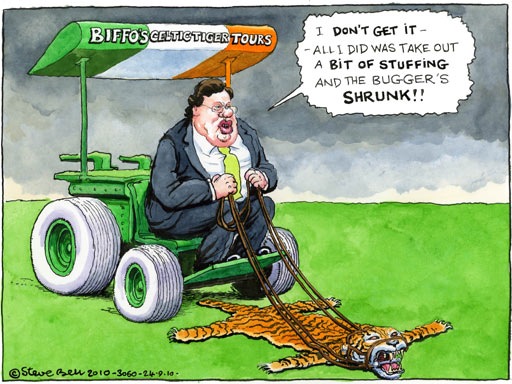
Oh, Burn! The Guardian's Steve Bell Takes Aim at Brian Cowen


Of course, now that the Brits are mocking him, I think Cowen's great!

How You Get to Taiwanese Style Approval Ratings ...and How You Recover

You'll remember that in an earlier post I discussed our Glorious Leader, Brian Cowen, putting the economic crisis on hold for a little while and travelling to Mayo in order to open a vitally important GP clinic. You will also remember that I was totally in favour of this, as the Taoiseach is required by law to support small businesses (which is what a GP clinic is, after all) that are subsidised by taxpayer-backed payment schemes (hellooo medical cards!), even if it is to the detriment of minor things like the 435,000 unemployed or the continuing collapse of our economy.

Thankfully, while Brian was in Mayo it wasn't all work, as he did have time to relax in the exclusive Mount Falcon resort (under the consitution, the Taoiseach and Ministers can only stay in accommodation to which the word "exclusive" is attached) and while there, according to Broadsheet.ie:
He started drinking at 4.30pm in Keane’s with Dara Calleary, Fianna Fail junior minister, and went on to a private room in the hotel with some “cronies”. Before retiring at 5am ... Two members of staff had to “link him with both arms to lift him up the stairs to his room”.
Clearly, the Mighty Biff's plan to manfully challenge the recession to a drinking contest is working, as Ireland is now on the frontpage of the Wall Street Journal, the poster child of good economic management...
 

Eh, sorry, no, that's actually a negative story, isn't it?

Unsurprisingly, yesterday's poll by Millward Browne Lansdowne for TV3 showed that, despite Brian's heroic carousing, the public are distinctly unimpressed with his record, with only 11% of respondents satisfied with the government, and only 18% approving of the Taoiseach.

However, Brian need not despair. Such poll ratings are, for me, reminiscent of the sort of approval that former Taiwanese President Chen Shui Bian received in both his first and second term in office. The lesson from another small island nation is clear, Mr. Cowen. All you need to do to rebound from this position of weakness, and for Fianna Fail to win the next election is to...

Be the target of a staged attempted assasination (althought I must point out that the allegation that attack was a mock-up was never proven).

And all you need to do is douse yourself in ketchup for the afternoon, while someone (who witnesses can claim looks a lot like Morgan Kelly) fires blank cartridges at you from a toy gun. Such a bold move, Mr. Cowen, such a tough decision, as to stage a pretend attempt on your own life will see you rise in the polls, crusining to victory, safe in the knowledge that you can piss everyone off again in your second term in office.

Plus, as a bonus, our Dail debates might start to look more like this:

Thursday, September 23, 2010

FF, Your Ego Is Writing Cheques the Economy Can't Cash!

"Good news" today on the job front - you will remember that SR Technics shut last year, leaving over one thousand out of work, and a number of apprentices with unfinished qualifications. Well, the Government, in its eternal wisdom and continuing desire to somehow create the illusion of given a rat's-ass about the unemployed, has announced that the Air Corps will be taking on 30 apprentices to finish their training with the Defence Forces.

That's a relief for the young men and women who will now be able to gain their qualification, and given the very tough year the former SRT employees have had, they deserve some respite. But it also represents further muddle-headed thinking from the Government, and either a lack of understanding or lack of interest as to how you actually create jobs. By taking these apprentices on with the military, at the tax-payers expense, we are merely substituting wealth-creating private sector jobs with a further drain on the over-burdened exchequer. Will these apprentices have to serve with the Air Corps when they have completed their training? If so, then was there an open competition for the apprenticeships, or were the spots gifted to former SR Technic's employees to save face for the Government? If the new apprentices do not have to serve with the Air Corps, then where is the benefit for our military air wing in providing this training?

If only there was somewhere else for these apprentices to complete their course - it's a real pity Ireland doesn't have one of the world's largest airlines headquartered in Dublin! I'm sure if that was the case, the Government would have bent over backwards trying to support such an airline, helping it establish the facilities it needed, and creating a healthy business environment. Then that airline might be able to provide jobs for those in the aviation sector who find themselves unemployed.

No, it's better to just squander Ireland's tiny military budget on trying to patch over the holes in the Government's employment policies, by providing training for apprentices without the promise of a job at the end.

That's much better.

Chastised by Seamy

One of the fascinating things about starting a blog is that, very occasionally, you find someone elsewhere on the web discussing something you've written. Such an event is even more intriguing when the cyberspace commentary on your words is provided by someone with very different political opinions to your own.
Such was the case yesterday when I noted that I had received traffic from the irishrepublican.net site, where my post on the Monaghan Soviet  was being discussed (and many thanks to the poster tireoghan for linking to this blog). One of the posters on the site, Seamy (which, my American friends please note, is pronounced "Shamey", not "Seemy") noted that my initial posting on Monaghan's revolutionary past had been somewhat incomplete, in that I suggested the Irish today were not prepared to engage in real political change, without providing any reasons as to why this inertia has developed. As Seamy put it himself:
So that fella's central arguement is that out of the blue, Irish people have become lazy, sluggish and politically disengaged without offering any credible explanations why. Does he fail also to grasp the basic concepts of dialectics which states that motion is never fixed and is always changing, the same can be applied to human nature and political attitudes. Yes, during the good ol' years of neoliberalism people were politically disengaged as naturally there is no real need to be when you have a more or less stable economic situation. However the financial crisis, the bank bailouts and now the frantic budget slashing all over Europe is waking people up to the realities of life under capitalism and drawing more and more previously apolitical workers and youth towards potentially revolutionary politics
In answer to Seamy's question, yes, I fail to grasp dialectics, mainly because I have no idea what the hell they are. Seamy is, unsportingly, using the unfair advantages often deployed by the left when I begin arguing with them: intelligence and big words. However, even my sluggish capitalist mind can, I believe, discern that Seamy is pointing out that the Irish may have become so addled with the comforts of the boom years that they are now incapable of revolution, reform or any other exciting r-words. I think that there is certainly some truth in this, although I would tend to argue (as did tireoghan) that this is due to a large section of our society still having a stake in the lies and falsehoods peddled by Fianna Fail. This is not just the big property developers either, but extends right through the citizenry of our "republic" - after all, the professional landlord/doctor/garda/teacher/shopkeeper with a few buy-to-lets are all just as fearful as Johnny Ronan of property trading at a realistic value. They too hope that we have "turned a corner" and that our Lazarus like recovery has begun.

I would also humbly point out to Seamy that to suggest that periods of plenty tend to dampen the ardour of the revolutionary spirit should result in the corollary that periods of want create the conditions for rebellion against the status quo. Yet the period of greatest need in the modern history of  Ireland, the Great Famine, resulted in only a tiny insurrection limited to one village in 1848, which can't compare to the events elsewhere in Europe over the course of that year.

By comparison, the rebellions of 1798 and 1916 occured in circumstances far less economically pressing than those of the Great Famine, yet something lit the touch paper of national consciousness, and the we rose up. In essence, it will take more than mere economic difficulties to get the Irish to seek change now - too many of us have a stake in the current system of government, and we do not seem to understand that the current FF government is ruling in the same manner as their British predecessors. The hunger for change is driven by emotion and a sense of justice as much as cold economics.

Seamy, if you (or any of your colleagues at Irish Republican) read this, I would be interested in hearing your thoughts.

Wednesday, September 22, 2010

Best Foreign Relations Video Ever

Taiwan's Next Media explains the current tensions between China and Japan using a cartoon Ninja and a Panda. This is how they teach international relations at Harvard, you know:

Princely, Enda Ain't!

There was a certain irony this morning to the fact that we had the philosopher Paul Brady on RTE 1 discussing the merits of Machiavelli's "The Prince" as a guide to the modern politician, while on Newstalk we had Charlie Flanagan, Fine Gael TD and spokesperson on Children's Issues, defending Enda Kenny's handling of the recently revealed scandal involving PJ Sheehan, another FG TD. On the one channel we had someone discussing the handbook for the politically ruthless, while on the other, we had waffle and spin designed to defend a decision which seems to define spineless weakness.

For those of you who don't know, and who couldn't be bothered clicking on the link, Mr. Sheehan was stopped by the Gardai leaving the Dail one night last July. He was, in the words of the attached article, '"extremely intoxicated" at the time, to the point that he required assistance to "remain upright"'. However, he insisted on being allowed to drive, and when the Garda in question tried to prevent him, she was told that her career was under threat and that "You'll get nothing from us when we're in power".

Leaving aside the delightful fact that Ireland has now been engulfed by two shameful political episodes in the space of less than a week, both involving alcohol, and from opposite sides of the house, what really stinks here is the complete absence of leadership FG are showing on the issue. Enda Kenny could not ask for a better opportunity to show off his political cojones! A 77-year old TD, who would probably not run in the next election, and who is only the Deputy Spokesperson on Agricultural Affairs is revealed to be undone by the demon drink, and in the process insults and threatens a servant of the state. Straight forward decision, Enda, red card him, announce that you when you are in power no one will be able to abuse their position for personal gain, and state categorically that those who work in the service of their fellow citizens deserve the respect of all. You come across as a great leader, statesmenlike and just, while simultaneously focussing attention on the Government and their refusal to can a Taoiseach who was, ahem, "hoarse" on the job. At worst, you annoy a few hardcore Blueshirts down in Cork South West who believe that it is every man's right to drive while drunk, and sure isn't that what Collins was fightin' for?

Instead, we again have the absolute absence of bravery in the Irish political arena. Kenny (who apparently only learned all the facts yesterday, even though the event happened in July, and Kenny was present at the time, and told the guard to ignore Sheehan!) has decided to deprive the good PJ of the mantle of Deputy Spokesperson on Agri- yadda yadda. So the bould PJ keeps his TD salary, keeps his expenses, keeps his perks, but merely has to stop pretending he cares about farmers nationwide, and can instead go on to only focus on the farmers of Cork South West. Magnificent.

We are always being told by the politicians how tough and underhand the party political environment is: how cut-throat can it be if even threatening a police officer won't lead to you getting the chop? Mr. Kenny, might I suggest you buy this book, and learn how this whole "leadership" thing is actually done.

Monday, September 20, 2010

An Irish Member of "the Few"

As yesterday was "Battle of Britain" day, and given my nerdish passion for aviation, I thought this would be a good opportunity to draw your attention to a somewhat forgotten member of that most noble of groups, "the Few", as the RAF pilots who won the Battle of Britain have become known.

Brendan Finucane (nicknamed "Paddy" by his colleagues - hey, in the 40's even the good guys were racist!) was born in Rathmines in Dublin in 1920. Given his father had been an active Republican during the 1916 Rising, his family would have been less than sympathetic to Britain. However, following emigration to England in 1936, and the development of a passion for flight, Finucane joined the Royal Air Force in 1938 (I would love to know what his father thought!).  

Finucane couldn't have known what lay just round the corner; after all, it was only in 1938 that the RAF was transforming from a "Gentleman's Flying Club" back into a truly operational airforce (indeed, on the BBC last night they interviewed a veteran who had only flown eight hours over the course of 1938. Eight hours! That really puts Britain's post WWI defence policy in perspective). Yet the young Irishman (only 19 when he first flew into combat) soon found himself fighting for the survival of European democracy. A meteoric rise saw him promoted to Wing Commander, and even claim the iconic German ace Adolf Galland as one of his victories - Galland, who was by all accounts an honourable man, thankfully survived.

However, the life of a pilot in the Second World War could be fleeting indeed, and sadly proved so in the case of Finucane. From acesofww2.com:

After attacking German shipping at Ostend and strafing three German airfields on July 15th, 1942, Finucane’s wing regrouped to return to Hornchurch. As the group passed low-level over the beach at Pointe Du Touquet, Finucane’s Spitfire was hit by machine gun fire that severely damaged his radiator. The engine overheated and quit, and the Spitfire was too low to allow Finucane to bail out. Losing altitude swiftly, Paddy was heard to say; “This is it, Chaps.” Witnesses reported that after a near perfect "splash" the Shamrock-Spit sank like a stone, and despite all efforts, was never to be seen again. At the time of his death, Wing Commander Finucane’s score stood at an amazing 32 victories.
The fact that Ireland's WW2 veterans and heroes have been forgotten is a shame that blights the island, and it is a fault seen in equal measure North and South of the border. In the South, we seemed inclined to ignore these men and women simply because most of them fought in British uniform, while in the North, rememberance of the Second World War has been sidelined by the mythology and fable of the Somme and Ulster's role in the trenches of the Great War.

It is, I feel, high time that Ireland, North and South, remember those men and women who fought not for the Queen, nor the Republic, nor Ireland, nor Britain, but for the simple rights of all peoples to live free from fasicist tyranny. The Battle of Britain was not simply a battle for Britain: it was a fight for the survival of the Europe we now take for granted, and for those ideals that have been Europe's greatest gifts to the world. That Ireland, or at least Irishmen and women, played some part in it should be a source of quiet pride.